Memoir of an American Valley Girl
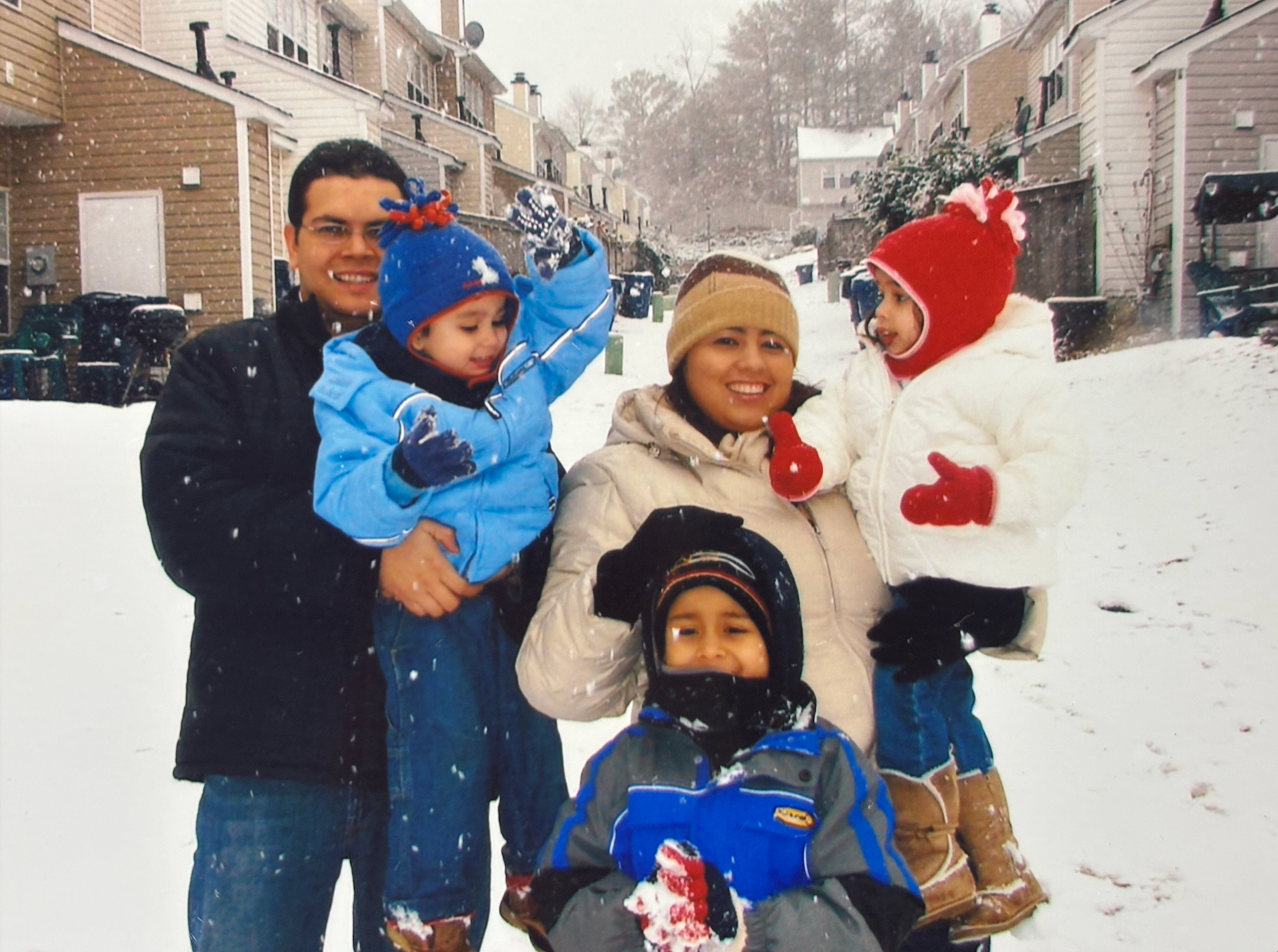
A picture from the winter of 2007. Pictured from left to right is my dad, cousin Nicholas, cousin Julian, my mom, and me.
There’s a place where every word spoken is a melody. The song starts low and warm with a hint of mischief, crescendoing into a brazen and bright falsetto. It’s an honest song, inviting and friendly, but written in isolation in the city of Medellín. You’ll find the Antioquian city buried within a steep valley along the Andes, surrounded by rolling hills of light, which, at night, look like stars against the stone sky. In its own world, with its own atmosphere, the people of Medellín live in a heaping, boiling bowl of chaos and part of that chaos is that melody.
My parents were both born in this valley. They grew up virtuosos in this language of song, seamlessly gaping and twisting their mouths, pinching and elongating their faces to form the notes of the Paisa accent. It’s something they could have only mastered in Medellín.
In the fall of the year 2000, my parents got a letter in the mail giving them permission to leave their home and start a life in America. The next winter, they packed their lives into new suitcases, which, years later, would still smell like their old apartment, like herbs and dust and smoke. My dad and mom would find work as janitors, scrubbing, mopping, and wiping their way through their new world. My aunt, uncle, and grandmother followed soon after them and moved into a two-bedroom apartment in Dunwoody. Four years later in 2005, I was born, the third American in our family after my cousin Nicholas.
My early childhood was spent in the homes of my family, who only really talked to one another. The only other people they exchanged words with were co-workers, who all spoke the same language as them, though with their own melodies and colloquialisms. English was still a foreign, complicated obstacle they didn’t know how to conquer. The more they understood it by ear, the less they could form the words themselves. Therefore, in the first few years of my life, I, like my parents, formed my first words and sentences to the same rising melody that they learned as children.
Like most kids, I grew up with the sound of my mom’s voice. At night, she would read me El Principito and sing me folkloric lullabies. I listened to my dad’s music: 80s Spanish rock songs by Soda Stereo and Los Prisioneros. I heard my grandmother’s petitions to God every afternoon when I sat by her feet as she sewed and recited La Ave Maria, the words of which were incomprehensible even as I recited them, yet still sacred to me all the same. I bore the hurled insults and whispered secrets of my cousins, who were my only friends, and who, like me, spoke with the same melodic speech as the rest of our family.
My childhood, so influenced by a place and people I did not know, was like a misplaced puzzle piece, one that belonged across the Caribbean and over a long stretch of mountains. It all came and went so quickly, but I remember it as a film through a stranger’s eyes. It would only be like this for a few years. Very soon, I would learn that my life had to be split in half.
When I was fifteen, my dad would play me a video off a dust-coated disc he found while rummaging through our attic. We played it on a miraculously functioning DVD player we hooked up to our old TV. When the static transformed into moving pictures, I saw myself as a little girl. I was wrapped up in a giant pink coat with a fur hood, white boots sinking into snow-covered ground. When I spoke, I heard a song that hadn’t escaped me in years. Though my words were a rapid mess of overlapping thoughts and made-up words, clear as day, I heard a girl from the valley. By that point, I had completely forgotten she ever existed.
That same summer, the same one I rediscovered the girl from the valley, I got my first job.
We had long since moved from Norcross to a town further up north called Alpharetta. In the nine years we’d lived there, real estate developers had transformed the once sparse rural community into the quintessential upper-class white suburbia. Suddenly, we had a town square with Tesla chargers, seafood restaurants, and boutiques.
In the middle of it all was Blue Moon Creamery and Confections, where I worked the night shift every weekend of that feverish summer. On my first day, I made an effort to endear myself to my coworkers the best I could. Most of the teenagers who worked in the town square came from the new, rich families that had arrived within the past few years, driving their Mercedes and Jeeps to work and wearing luxury athleisure beneath their uniforms. Even so, they were the same kind of yellow-haired, Baptist, red-blooded American kids I had been surrounded by all my life. I knew how to micro-manage my words, how to make them laugh, how to make them like me. I had never spent so much time around American kids before, since all my friends came from immigrant backgrounds, and, embarrassingly, their acceptance delighted me. The gaping ravine that separated me and my all-American peers was closing with every shift I took up, and I felt the ground shifting with the increasing drawl in my voice, coloring itself with the Southern twang that never quite stuck even after years of living in Georgia.
The illusion was shattered by August, when, at the tail-end of a double shift, my forearms covered with streaks of sticky ice cream, I felt a nudge on my shoulder. My coworker, Lily, a slight, friendly blonde with a sweet voice, said, “You know Spanish, right?” It was not phrased as a question.
“Of course!” I said, with a hint of irony.
She smiles. “So you can take their order?” She gestures to a family, a mother, a father, and two children, waiting behind the ice cream counter. The kids, two boys, have their hands splayed on the glass, stretching on their tippy-toes to see the flavors, the possibilities. I can tell they’re Latino by the width of their cheekbones and the tawniness of their skin. I can also tell, by the embarrassed arrangement of the mother’s features, an expression I’d often seen reflected on the faces of my own parents, that the mother and father didn’t understand Lily when she tried to take their order.
“Yeah, I can do it,” I say. “Can you clean this up?” I add, pointing to the spill of chocolate sprinkles I had been sweeping. It was not phrased as a question.
I greet the family in Spanish, asking the boys if they like vanilla or chocolate better, and that yes, they can get two flavors if their parents allow it. I stutter on a few words, but soon they start flowing out of me like a song I realized I knew all the lyrics to. As I lead them to the cash register, the mother asks me where I’m from. It’s been years since someone asked me that question, and I smile, remembering the video I’d seen earlier that year as I tell them that “I’m Colombian.” They’re from Venezuela, I found out. As I hand them a receipt, I tell them that I hope they return soon. They tell me that they hope I’m here when they do.
With a warmth in my chest, I close the cash register and catch the eye of two girls standing a few feet from me, each with a cone in their hands and an odd expression on their faces. Switching back into the bright drawl that generated me many a twenty-percent tip, I ask them if they’d like me to check them out. They don’t answer me, instead looking at each other with something between a sneer and a grin.
After what must have been a second, but for me, stretched into a century, one of them turns to me, and with an awkward curl of vowels in her unpracticed mouth, she says, “No gracias.” Even with the pit in my stomach, the first thing that unfurls in my head is how terrible her pronunciation was. My second thought was the realization that it was on purpose. She intended to mock the display she witnessed between the Venezuelan family and me in a public space, so out of place, so hostile to her and the sheltered town we lived in.
For the rest of the night, I felt the lingering sting of those two words. It hadn’t been the first time I’d been on the receiving end of someone’s prejudice. My peers at school called me names and made jokes about my presumed illiteracy, but those comments hardly affected me. Mostly because I knew they were wrong. I was at the top of my class in English, and my control over the language far surpassed theirs. But this was different. It wasn’t my intelligence that was being questioned, but rather my existence that was being berated. There was something volatile behind those words. They meant to pierce me with them, and it angered me that they succeeded in doing so. For the most part, though, I was confused. Confused at the notion that they felt they were allowed to speak to me in that way. That the disdain coating the hateful rhetoric I’d so often read on my phone could be spoken aloud in public, at my place of work where I’d so carefully curated my identity to blend into the world around me. How could it all be shattered in a five-minute conversation and two ill-spoken words?
Later, when night fell and I had collapsed into the passenger seat of my dad’s car, is when the shame set in. I felt a familiar heaviness below my ribs, so visceral that my body slumped with the weight of it. I thought of the girl in the video again and her melodious voice, how free she felt before she knew how large the world was, and how she didn’t quite fit into it.
In retrospect, it wasn’t until Alpharetta that I realized it, but I suspect that I would have found out sooner or later even if I had stayed in Norcross. What I’m sure of is that Alpharetta is a small town that felt terrifyingly big to me when I first moved there, with its sprawling green pastures and never-ending roads that would become unnavigable at night.
Along one of these roads, coated in flaking brown and green paint, was my new school. The day my cousin Nicholas and I were enrolled at Midway Elementary, our parents begged the administrators to place us in the same classroom. We hadn’t been taught in the same room since pre-school, both of us wanting to split up and make our own friends outside the childhood we spent attached like Siamese twins. But the move had changed us. I, once so sociable and curious, became withdrawn and more sensitive than ever, prone to bouts of uncontrollable crying that no one could diagnose the cause of. Nicholas, the most adventurous of us, became reclusive, spending his afternoons watching cartoons and playing video games rather than running around the backyard with a soccer ball.
On our first day, we refused to separate, sitting by one another in silence as all the other children chattered amongst themselves. Occasionally, they would sneak glances at the two of us and whisper about how we — the silent pair — came to live in their unchanging, little school. On the second day, though, their whispers, too loud and uninhibited, reached our ears.
“Are they really brother and sister?” a girl asked, with an unwavering stare. Nicholas and I sat at a table with her and another girl.
“I don’t know,” the other replied. “I don’t think they speak English.”
I stayed quiet, but Nicholas looked up from his work to say, “We’re not brother and sister. We’re cousins.” He didn’t need to say anything else. The girls nodded and giggled, and from then on, Nicholas and I didn’t sit together in class anymore.
Over time, he became the type of child who spoke up, who made himself seem bigger, more special in the eyes of our teachers and peers. He made friends with the other boys in our grade, boys with sparkly blue eyes and superhero lunch boxes who accepted him because he could run fast and played soccer better than any of them. He started going by “Nick,” and I couldn’t say that name without feeling discomfort, so I stopped calling for him at all unless we were home, unless I could call him Nicholas with a long ‘e’ and the accented “a.” “N-eee-koh-lás.”
I, on the other hand, remained quiet. Rarely would I raise my hand to answer a question or make efforts at conversation with the other children. When the teacher called my name, I wouldn’t answer because no one had ever pronounced it in that Americanized way, with the curling vowels and unrolled “r.” Eventually, she just stopped saying it.
When ESOL classes began during the second week of school, I was immediately assigned to attend. Every day in a small, sun-lit room, I, along with half a dozen other children, was instructed on how to read and write in English. The curriculum was taught by a short woman with a sweet Southern accent, Mrs. Krawiec, who conducted sessions by reading passages aloud and having us write down what we heard on a piece of printer paper. Once we wrote down four sentences, she would skim over our words with a critical eye, and if it satisfied her, she’d let us go back to our classrooms. I was usually the last to leave, often left alone staring down at the bright, empty page before me, eyes brimming with tears.
My teachers figured I wasn’t very good at reading or writing because I was not placed in ESOL at my last school. It became a concern after our state-sanctioned exams came back in the Spring, and my score in language arts was one of the lowest in the class. The school told my family that we had to start speaking English at home if I was to succeed, and they, with visions of framed diplomas and houses with thicker walls, heeded the suggestion.
That summer, for the first time, we started speaking English at the dinner table. My mom started giving me my older cousin’s old books, Harry Potter and Shel Silverstein collections, which were left stacked in a dusty pile by my vanity. At my aunt’s house, everyone would speak to me only in English, and, soon, to each other as well. At first, I was annoyed. I didn’t want to ask for “rice” instead of “arroz,” or watch cartoons in English, or start calling my cousin Nick. It wasn’t until I started to make friends with the American kids on the block that the change stopped bothering me, and my mouth began to relax when I formed English words. I didn’t know it at the time, but my young mind was longing for companionship, and the only way to belong to the world beyond my home was to embrace its confounding language.
When the new school year came around, I started speaking more. I responded to my new Anglicized name and made friends with the children I’d effectively ignored the year prior. At lunch, the girls I sat with would take out plastic-wrapped sandwiches and potato chips, and soon, my parents would start packing me an identical meal. I received invitations to birthday parties and soccer games, and the boys whose looks once grazed past me started making me Valentine’s cards.
My English rapidly improved, delighting my teachers even with my subpar performance on reading and writing tests. It was my socialization that seemed to matter the most to them. Meanwhile, at home, I spoke to my parents less and less, my words too quick and unfamiliar to their ears. Eventually, their own frustration set in, and instead of asking me to respond to them in English, they had to remind me to speak to them in Spanish. Still, even with my delayed embracement of the American language, I began to forget how I used to form words in Spanish, like an instrument I abandoned to learn another of more value.
At grocery stores and shopping malls, which, unlike those in Norcross, only had English-speaking staff, I began to notice the way my parents would fumble over their words. They stuttered and repeated themselves until their voices neared shouting volume, and I, expecting that someone, a teacher maybe, would come out and reprimand them for it, would stand unflinchingly still behind them, hiding. At restaurants, I felt a shift every time a server would stop by our table, how my parents’ flowing, melodic voices would become fragmented and stilted when they were forced to speak English.
In my mind, Spanish was the language of home, and, without my knowing it, Spanish rock and El Principito became the music and literature of home. When these things which I believed could only exist in private encroached on the outside world, it disrupted the fragile balance I’d created between the remnants of my childhood, influenced by the valley I hadn’t seen in years, and the future I wanted as a normal American girl. As if to remedy this, I let the scale tilt until I felt safe again, until English filled every silent room besides my kitchen and I forgot how to say my own name the way my mother first spoke it.
It was a gradual shift that grew more unbalanced with every year that passed. By middle school, I had picked up my first novel, and my desire to conquer English grew, though more out of a passion for stories than one for belonging. My vocabulary expanded as a result of my literary nourishment, and I even began to keep a notebook to write my own tales. It was then, when I could only create worlds and scribble endlessly about my emotions in English, that I stopped being a valley girl.
In high school, I bridged the gap between proficient and advanced. I was given a spot in college-level English classes and became the Arts editor for our school newspaper. It didn’t escape me how I was the only Latin girl in both of these rooms, nor did it escape my peers, who, without really knowing me, made comments about how incompetent I must’ve been for being so. In spite of this, at the end of my senior year, my school would hand me an award for “Best in English” during a ceremony for the most distinguished members of my class, a ceremony my parents didn’t attend.
When I stared out at the kids I’d known my whole life, who once accepted me as children, but soon learned of the insurmountable difference between us, one that made itself known not just by the different sounds we heard as young children, but by the color of our skin and slope of our noses, the pride that momentarily swelled in me all of a sudden felt empty. I remembered the two words, and the whispering, and the lonely rooms; I remembered the insults, and the printer paper, and the curling of vowels; I remembered my old name, and “N-eee-koh-lás,” and the melody I hadn’t sung since I was seven. It all felt wrong. Like I wasn’t the girl that was supposed to be on the stage, that they chose the wrong person, and even with my tilted scale, practically moot by then, didn’t erase the fact that, though I didn’t belong to the city across the Caribbean and over the Andes, I didn’t belong to America either. And still, despite it all, there I stood.
The American Girl. The Valley Girl.
Both. Neither.
For the first seven years of my life, I dreamed in Spanish. When I stopped, my dreams changed. They look like this: Me, in a classroom, reading great books and writing until my fingers ache. Me, in a newsroom, telling stories about all the interesting things and people I see. Me, in a city so big and bustling, it doesn’t have time to question if I belong in it. Me, in a house with thick walls and a framed diploma hanging above the fireplace.
Sometimes I think that dream has become my life. Other times, because no city is big enough, I know it never will. Still, I keep writing and speaking in the language I’ve come to love, even when it’s wielded against me, all while trying not to forget the girl in the pink coat. Denying she existed is denying who I am, and I’d rather belong to nowhere than forget the rising melody of the valley.